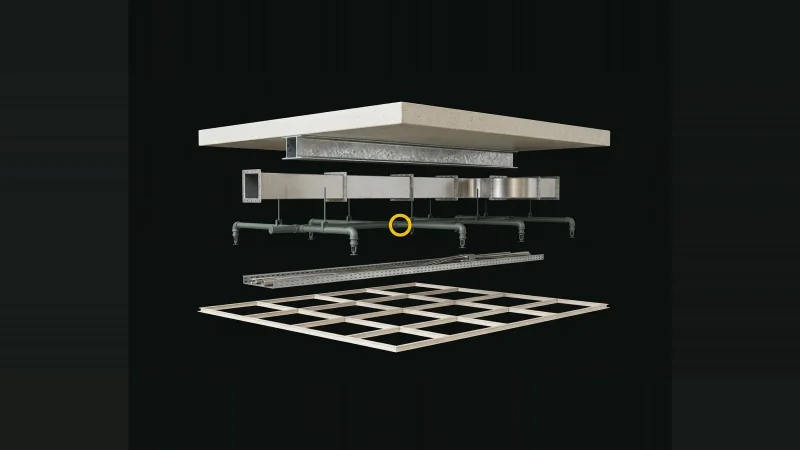
MEP scope conflicts do not announce themselves. They hide in the gap between a mechanical drawing and a plumbing spec. They sit in the ceiling coordination zone where three trades compete for the same 18 inches. They wait in the fire-protection notes that contradict the architectural reflected ceiling plan.
By the time a sub flags the conflict, tender has already closed. The GC owns the gap.
This article explains where MEP conflicts come from, why standard document review misses them, and how RFI Agent changes the discovery workflow before your bid goes out the door.
MEP work is inherently cross-disciplinary. A mechanical engineer designs ductwork routing. A structural engineer designs the beam layout. An architect draws the ceiling. None of them is working from a single coordinated model in real time.
The result: conflicts are baked into most document sets before the first addendum drops.
The Scope Gap Playbook, built from more than 200 GC interviews, identifies MEP as the trade division with the most recurring and costly scope gaps on institutional builds. The specific conflicts that show up most often include:
These are not edge cases. They are patterns. And they repeat project to project because the document review process has not changed.
For a deeper look at how MEP conflicts compound into change orders, see the trade-specific scope gaps chapter of Provision's Scope Gap Playbook.
Most pre-construction teams review documents one file at a time. An estimator opens the mechanical drawings, works through them, then opens the specs. The conflict between those two files only becomes visible when someone holds both in their head simultaneously.
That is not a people problem. It is a process problem.
A senior estimator at a Canadian ICI GC put it plainly in the Scope Gap Playbook interviews: "If you miss anything, they'll bill it." The subs know the gaps. The GC absorbs them.
The five-minutes-before-bid review is one of the most common anti-patterns in pre-construction. Teams pull the document set when the clock is running, scan for obvious omissions, and ship the bid. Cross-document conflicts require time and a cross-file read. Almost no manual process delivers both under bid-day pressure.
The question is not whether conflicts exist in your document set. They almost certainly do. The question is whether you find them before or after tender closes.
Provision's RFI Agent reads your drawings and specifications against each other. It does not review one file at a time. It looks at the full document set together and surfaces conflicts, omissions, and unclear requirements across the whole set.
On a typical institutional document set, RFI Agent surfaces more than 100 potential issues in an hour. That is not a scan. It is a cross-referenced read of everything you uploaded.
Every finding carries its source evidence. Each potential conflict is traced to the exact specification page or drawing where the issue originates. Your team can verify any finding in seconds, without digging back through hundreds of pages.
RFI Agent is not running a keyword search. It is reading for logical consistency across documents. In MEP scopes, that means it looks for things like:
The output is a reviewed issue report. It is not a finished RFI package. It is the shortlist your estimator takes into the owner and design team conversation before tender closes.
RFI Agent does not issue anything automatically. It does not push findings into your project management system without review. Every potential issue lands in a list your estimator reviews.
For each finding, the estimator sets the action. The options are:
The estimator filters findings by impact, conflict type, discipline, and review status. That means you can sort MEP issues by severity, review only the structural conflicts, or pull every finding tied to a specific drawing set.
When you have worked through the list, RFI Agent exports the reviewed shortlist as one report. That report goes to the owner and design team.
This workflow keeps your estimators accountable for what gets submitted. The tool surfaces the candidates. Your team makes every call.
The cost of a missed MEP conflict is not theoretical. The Scope Gap Playbook documents a $300K lead-lined glass omission on a hospital imaging suite. The GC absorbed it under readily inferable contract language. The conflict was visible in the document set. Nobody caught it before bid day.
Generator field-conditioning costs are another recurring example. The scope is undefined. The spec is silent. After award, the GC and the mechanical sub argue over who owns a cost that runs into the hundreds of thousands on large institutional projects. The document conflict was there at tender. The resolution comes later, in a change order conversation the owner does not want to have.
The Arcadis Global Construction Disputes Report puts the average North American construction dispute at $60.1 million. Errors and omissions in contract documents rank as a leading dispute cause in North America. MEP conflicts fit squarely in that category.
Finding them before tender closes is not a process improvement. It is financial protection.
Clark Construction used RFI Agent during pre-construction on a live project. Markee Foster, Project Manager at Clark, reviewed the findings the tool surfaced.
"I went through the first 30, and of the first 30 I picked close to 22 that I would have submitted as RFIs. It turned out that some of the subs we've been working with caught the same things."
The subs caught the same things. After tender closed. That is the gap RFI Agent closes. For more on how Clark Construction uses Provision in pre-construction, see the Clark Construction case study.
RFI Agent works with digital drawings and specifications. You upload your document set, and the tool reads the full package. There is no manual file-by-file intake.
The workflow fits into tender review without replacing your estimators. It runs in parallel with takeoff and scope development. By the time your team is ready to issue ITBs, the conflict report is ready to review.
RFI Agent is not the same product as Risk Review. Risk Review is the right tool when you need to run a contract checklist, compare your exposure against standard positions, or surface commercial risks in supplementary conditions. RFI Agent is the right tool when you need to read the drawing set against itself and find where it contradicts, omits, or stays unclear.
Many pre-construction teams use both. They are different workflows that address different risk windows.
If you also need to generate coordinated trade scope packages from your document set, Scope Agent handles that separately. Scope Agent extracts trade-specific scope items with 97.01% match accuracy and classifies them by subcontractor trade at 96.02% accuracy (Top 2). It is the scope generation workflow. RFI Agent is the conflict discovery workflow.
And when your team needs fast answers from a large document set during the bid period, Chat Agent returns cited, source-backed answers in under 20 seconds across drawings, specs, contracts, RFIs, and addenda.
Not every finding becomes an RFI. Some conflicts are worth qualifying in your bid. Some are worth raising in a pre-bid meeting. Some are design coordination items the owner already knows about.
RFI Agent does not make that call. It surfaces the candidates and gives your estimator the evidence to make an informed decision quickly.
That is the right division of labor. The tool does the cross-document read. Your estimator decides what matters and what action to take. The report that goes to the owner reflects your team's professional judgment, backed by evidence from the document set.
If you want to see what that looks like on a real project, request a demo and walk through a live document set with the Provision team.
MEP conflicts in pre-construction follow a predictable pattern. They originate in the gap between drawings and specs. They go undetected during manual review. They surface after award, when the sub has the leverage and the GC has the exposure.
The eight habits that separate high-margin pre-construction teams from the rest, documented in Provision's Scope Gap Playbook, include reviewing drawings against specs before bid day, not after. RFI Agent is built to operationalize exactly that habit at scale.
More than 100 potential issues in an hour. Every finding source-traced. Every action decided by your estimator. One clean report to take to the owner.
That is what drawing conflict detection looks like when it works.
Drawing conflict detection means reviewing mechanical, electrical, and plumbing drawings against each other and against project specifications to find contradictions, omissions, and unclear scope boundaries before tender closes. Conflicts caught at this stage can be resolved via RFI or bid qualification rather than absorbed as change orders after award.
Provision's RFI Agent reads drawings and specifications together as a full document set, not one file at a time. It surfaces conflicts, omissions, and unclear requirements across all uploaded files, tracing each finding to the exact specification page or drawing. It surfaces more than 100 potential issues from a typical institutional document set in an hour.
No. RFI Agent produces a reviewed issue report for your pre-construction team. Your estimator reviews each finding and assigns an action: RFI, bid qualification, clarification, trade coordination item, mitigation action, or no action. Nothing is issued automatically into your project management system.
Risk Review is a contract and spec checklist workflow. It surfaces commercial exposure in supplementary conditions and contractual clauses. RFI Agent is a drawing conflict workflow. It reads your drawing set against itself to find contradictions, omissions, and unclear scope. Many teams use both: they address different risk windows in pre-construction.
RFI Agent looks for logical inconsistencies across documents: equipment specified in mechanical drawings without a corresponding electrical service callout, fire suppression requirements that contradict between divisions, lighting controls referenced in drawings but absent from specs, and undefined scope boundaries between mechanical and electrical trades, among others.
RFI Agent produces a reviewed issue report filtered by impact, conflict type, discipline, and review status. Each finding includes source evidence traced to the exact specification page or drawing. After your estimator reviews and assigns actions, the tool exports the shortlist as a single report your team takes to the owner and design team.
Yes. RFI Agent works with digital document sets including addenda. As revised drawings and updated specifications arrive, you can re-run the review against the updated set. This matters on fast-moving institutional tenders where addenda can change scope ownership in MEP divisions right up to tender close.
RFI Agent reads your full drawing set and surfaces 100+ potential issues in an hour.
See it in actionMore Articles