Conveying equipment is one of the cleaner-looking scope packages on a bid. One sub. One spec section. One price. The elevator company shows up, installs the cab, and leaves.
That story holds right up until you're sorting out who pays for the load test, who set the rail bracket inserts, and who the authority is waiting on for the acceptance inspection.
Testing and certification was the top-flagged job in Division 14 on Provision's Scope Gap Index, Q3 2026. It appeared in 16 of 22 packages, a 73% flag rate. That is not a data anomaly. It is a consistent pattern across 19 projects from 16 general contractors.
This post breaks down what gets missed, why it keeps getting missed, and how to close the gaps before the bid goes out.
Elevator scopes feel complete because the spec is detailed. The manufacturer's requirements, the cab finishes, the door configurations, the drive system: it is all in there. Estimators read the spec, confirm the sub covers supply and install, and move on.
The problem is what the spec requires without naming a trade.
The elevator sub's standard exclusions are long and well known in the industry. Load tests, acceptance inspections, power connections, hoistway surveys, hoist beams, interim maintenance: these items sit outside the sub's standard scope. The sub assumes the GC handles them. The GC's scope sheet often says nothing about them at all.
That is the gap. Not a disagreement about what the work is. A silence about who does it.
The Scope Gap Playbook calls this pattern out across specialty trades: the documents describe what the system does, not who provides the conditions for it to get installed. Division 14 is one of the clearest examples.
Provision's Scope Gap Index covers 1,290 scope packages generated by Scope Agent between July 17 and September 30, 2026, across 24 projects from 16 general contractors. Division 14 had 22 packages across 19 of those projects.
Of 370 flags in Division 14, 323 were inferred and 47 were coordination flags. That 87% inferred rate is the highest of any division on the Index.
Inferred means Scope Agent judged the job necessary and found no scope naming who does it. Coordination means the job sits between two trades. Neither is a confirmed omission on a specific project. They are flags for an estimator to review.
Here is the full ranking for Division 14:
Source: Scope Gap Index, Division 14, Q3 2026. 22 packages across 19 projects. Flags are Scope Agent's judgment; fewer than 1 in 100 items had been reviewed by a person at the time of counting.
The authority's acceptance inspection, the load test, the fire service recall test, and the certificate to operate were flagged in 16 of 22 packages. All 16 were inferred flags. Only one was a coordination flag.
The spec requires these items. The question is who schedules them, who attends, and who pays for a re-inspection if the car fails. Those three things need to be in the scope. If they are not, the sub will not price them and the GC will carry them as a surprise late in the project.
On institutional projects, the inspection sequence gets more complex. Fire service recall testing requires the fire alarm sub to be present. That is a coordination item, and it needs to be in both scopes.
Close it with two or three explicit lines: who arranges the inspection, who attends from the GC's team, what the re-inspection provision is, and whether the fire alarm sub has a named obligation.
Rail bracket inserts in the hoistway walls, pit ladder and buffer anchors, sill angles, and power and telephone connections in the machine room. These were flagged in 15 of 22 packages: 12 inferred, 7 coordination.
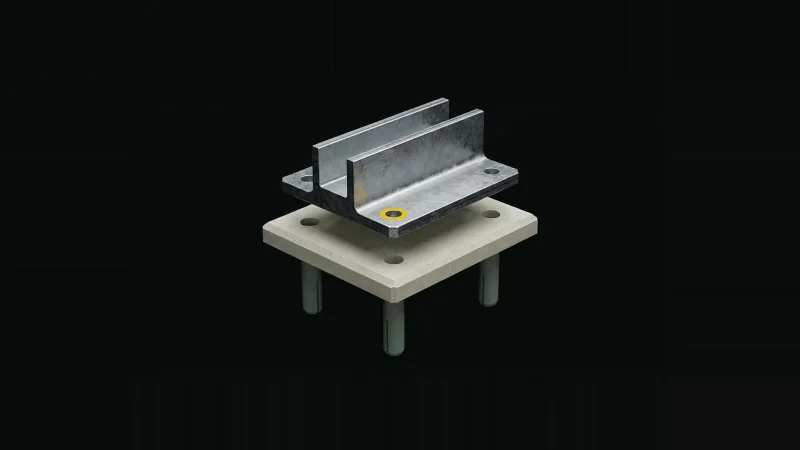
The pattern is straightforward. The elevator sub needs an embed set into the concrete or masonry to hang the rail bracket. The drawings show the embed. Neither the concrete sub's scope nor the elevator sub's scope says who buys it or who sets it.
This is the same gap the Scope Gap Index finds in Division 03 and Division 05 across nearly every project. In Division 14 it is amplified because the hoistway is a confined space with a tight construction sequence. Getting the inserts in after the walls are poured is expensive.
Close it by naming who supplies and sets each insert type, who surveys the hoistway before rails are set, and who makes each mechanical and electrical connection.
All 14 flags were inferred. Zero coordination flags. That tells you something: this work is not landing between two trades. It is landing in nobody's scope at all.
Getting the machine and the cab into the building requires a hoist beam in the overhead, a crane or hoist for a machine-room-less (MRL) unit, and a delivery plan for the cab panels and rails into the hoistway. The elevator sub will tell you what they need. The scope sheet needs to say who provides it.
Two lines close this. Who provides the hoist beam. Who does the lift.
Hoistway plumb and dimensional tolerances, the pit depth and overhead clearance the sub needs, and the sill interface against the flooring sub's finish. Flagged in 14 of 22 packages: 11 inferred, 7 coordination.
The elevator sub has specific structural requirements for the hoistway. If those tolerances are not met before rails are set, the sub stops work. Who surveys the hoistway, who is responsible for correcting out-of-tolerance conditions, and who coordinates the sill with the flooring finish needs to be explicit in the scope.
Eleven of 22 packages, all inferred. This is a category that hits institutional projects particularly hard, especially in 2026 when hospital, transit, and education clients have formal commissioning and handover requirements.
The issues are specific. When does the warranty start if the car is used for construction hoisting during the project? Who maintains the cab between mechanical completion and occupancy? What service contract does the owner need in place on day one? The spec often requires all of this. The scope sheet often names nobody to carry it.
Ten inferred, one coordination flag across 11 of 22 packages. Sleeves into the hoistway for power and fire alarm, machine room penetrations, and firestopping the hoistway wall.
The pattern is the same one that appears in Division 07, Division 21, and Division 26 across the Index: the pipe or conduit goes through a rated wall and nobody's scope names who sleeves the hole, who seals it, and who signs the firestopping certificate. In a hoistway, that is a building code item, not an optional line.
The Scope Gap Playbook identifies a set of anti-patterns that produce gaps on nearly every project. Several apply directly to Division 14.
Sending the full spec section and asking the elevator sub to quote it is not a scope package. It is a document transfer. The sub will read the spec, price what they typically include, and exclude everything else in their standard terms. The GC gets a number. The number does not cover testing, the hoist beam, or the inserts.
As a Pre-Construction Lead at a Top-ENR Canadian GC put it: "If you miss anything, they'll bill it." That framing captures Division 14 exactly. The sub has the standard exclusions ready. They are not hiding them. They are just not in the GC's scope sheet.
Reusing last year's elevator scope on this year's institutional project is how warranty and maintenance language gets missed. The last project was an office building with standard turnover. This one has a hospital commissioning authority and a 12-month deficiency period. The scope needs to reflect the project.
Reviewing the scope package right before bids close is too late to address a question about who provides the hoist beam. The Scope Gap Playbook chapter on subcontract language calls for a pre-issue scope review checkpoint. For conveying equipment, that checkpoint needs to include the GC-provided items list from the elevator sub's standard exclusions and check each one against the scope.
The dollar figures on conveying equipment scope gaps are project-specific, but the pattern is consistent. Load tests and re-inspections are line-item invoices from the certifying authority. Hoist beam supply and installation is a separate cost the GC did not carry. Interim maintenance at $X per month for a 60-day occupancy delay is a real number on a real project.
The Arcadis Global Construction Disputes Report puts the average North American construction dispute at $60.1 million, with errors and omissions in contract documents ranking as the top cause in North America. Not all of that is Division 14. But scope silences in specialty trades are exactly the kind of omission that generates a dispute.
The $300K lead-lined glass gap documented in the Scope Gap Playbook followed the same logic: the spec required it, nobody's scope named who supplied it, and "readily inferable" language put the cost on the GC. An elevator hoistway with unassigned inserts and testing obligations is structurally the same situation, at a smaller but still material scale.
None of these items are complicated to write into a scope. They are just easy to skip when the estimator is working through 40 trade packages before bid day.
Use the elevator sub's standard exclusion list as your starting point, then confirm each item appears in either the elevator sub's scope or another named trade's scope:
Provision's Scope Agent reads your drawings and specs together and flags inferred and coordination items before the package goes to subs. On Division 14, it surfaces the hoistway-dependent items the spec requires but no scope assigns. Your estimator reviews the flags and decides what is real on that project.
See more on how Scope Agent works across trades in the Division 14 Scope Gap Index page.
Institutional construction is driving a larger share of ICI project volume in 2026. Hospitals, transit facilities, and education buildings all carry more complex conveying equipment specs than commercial office work. Multi-cab systems, larger pit requirements, fire service integration, and strict commissioning authority processes make each of the gaps above more likely to appear and more expensive to resolve after award.
If your pipeline has more institutional work this year, Division 14 deserves more than a copy-paste scope. The testing and certification sequence alone on a multi-cab hospital project can involve three separate regulatory authorities. Each one needs to be in a named sub's scope or confirmed as a GC allowance.
The Scope Gap Playbook's eight habits for scope writing are worth revisiting if your team is moving into more institutional work. Habit 1 (drawings-first, not boilerplate-first) and Habit 6 (sub-specific tailoring) apply directly to conveying equipment on complex projects.
An inferred flag means Scope Agent judged that a job is necessary based on the drawings and specs, but found no scope package naming who does it. It is not a confirmed omission on a specific project. It is a flag for an estimator to review against the actual bid documents. Division 14 had 323 inferred flags out of 370 total, the highest inferred rate of any division on the Index.
The elevator sub's standard scope covers supply and installation of the equipment. The authority's acceptance inspection, the load test, the fire service recall test, and the operating certificate are typically excluded. The spec requires them. The GC's scope sheet often names no one to carry them. That silence produces the flag in 73% of Division 14 packages on the Scope Gap Index.
The elevator sub needs a hoist beam to lift the machine and cab components into the hoistway. Standard elevator sub scopes exclude hoist beam supply and installation. The GC scope needs to assign this explicitly: who supplies the beam, to what specification, and who performs the lift. All 14 hoist beam flags in the Q3 2026 Index were inferred, meaning no scope named an owner.
The top coordination items in Division 14 are anchors and embeds (12 inferred, 7 coordination in 15 of 22 packages), tolerances and trade interfaces (11 inferred, 7 coordination), and blocking and support (6 inferred, 6 coordination). These are items that sit between the elevator sub and the concrete, electrical, or flooring sub, with neither scope naming who handles them.
If a car is used for construction hoisting before occupancy, the warranty start date becomes ambiguous. The sub may argue the warranty started at mechanical completion. The owner may expect it starts at occupancy. If the scope does not define the warranty start date and the maintenance obligation between turnover and occupancy, that ambiguity becomes a dispute. It was flagged in 11 of 22 Division 14 packages, all as inferred items.
The scope needs to name who sleeves penetrations into the hoistway for power and fire alarm conduit, who applies the firestopping material at each penetration, and who provides the inspection certificate. Without all three, the obligation is unassigned. It was flagged in 11 of 22 Division 14 packages, with 10 inferred and 1 coordination flag.
Yes. Scope Agent reads the full project document set, including drawings and specifications, and flags inferred and coordination items by trade and division. For Division 14, it surfaces the hoistway-dependent items the spec requires but no scope assigns. Your estimator reviews each flag and decides what applies to that project. See how it works on the Scope Agent page.
Scope Agent flags testing, hoisting, and embed gaps before the bid goes out.
See Scope AgentMore Articles