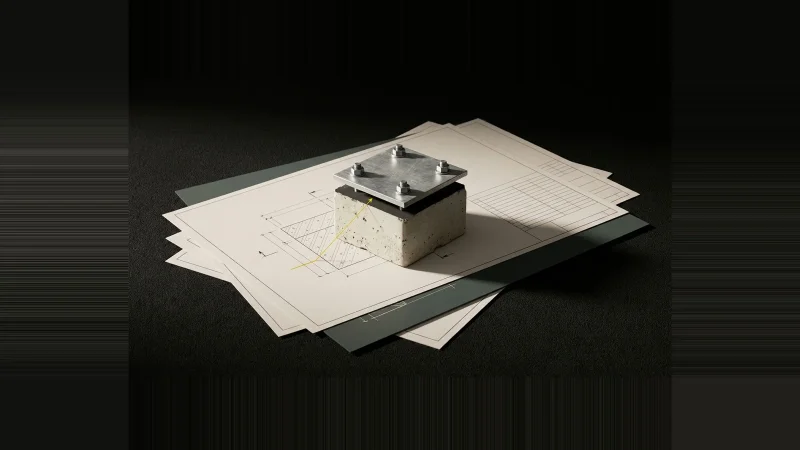
Structural steel is going up. The iron workers have bolted the first columns. The concrete sub has finished the slab pour. Then someone asks: "Who's grouting the base plates?"
Silence.
This is not a rare situation. It plays out on commercial, institutional, and industrial projects across North America — every year. The concrete sub says it's structural steel work. The steel sub says it's concrete finishing. The GC is stuck in the middle with a field crew waiting and a change order forming.
The problem started at bid, not in the field. And it started because nobody wrote it down.
Grouting base plates is load-bearing work. It transfers column loads to foundations. It's not a finish — it's structural. If it's done wrong or late, it affects the entire steel erection sequence.
The material is typically non-shrink cementitious grout. The work requires tight tolerance, proper curing, and coordination with the steel erector's schedule. It is not something a concrete crew can just swing back to do between pours.
Structurally, this work belongs to the concrete scope. Sequentially, it belongs to the steel erection schedule. That tension is exactly why it falls through the cracks.
Most project specs reference base plate grouting in Division 03 (Concrete) under section 03 60 00 (Grouting) or 03 62 00 (Non-Shrink Grouting). Some specs reference it in Division 05 under structural steel installation notes.
Here is the problem: specs often describe the product and the method. They rarely assign the trade. When a spec says "Contractor shall install non-shrink grout at all base plates per manufacturer's instructions," it uses "Contractor" — not "concrete subcontractor" or "steel erector."
In a design-bid-build delivery model, "Contractor" means the GC. The GC then needs to assign that scope to a sub. If the GC doesn't explicitly do that in the scope sheet, nobody prices it.
Here is a typical sequence. It's not hypothetical — it's pulled directly from patterns documented across 200+ GC interviews conducted for the Scope Gap Playbook.
This is a textbook scope gap. It was predictable. It was preventable.
The most common anti-pattern in GC scope sheets — documented repeatedly in the Scope Gap Playbook — is the phrase "as per plans and specs." It sounds complete. It isn't.
"As per plans and specs" doesn't assign a trade. It doesn't tell a concrete sub that base plate grouting is their scope. It tells them to read 2,000 pages and figure it out. Most subs read what they know and price what they see. If they've never owned base plate grouting before, they won't price it.
A Pre-Construction Lead at a Top-ENR Canadian GC put it plainly: "It's descriptive — bread, put it on a plate, use the open jar. You have to get to that level of detail or else they'll just be like, 'you didn't tell us that.'"
That's the peanut-butter test. If your scope sheet doesn't spell out that the concrete sub is responsible for non-shrink grouting at all structural base plates per Section 03 62 00, you have not been descriptive enough.
Base plate grouting is one of several concrete-related scope gaps that show up regularly across commercial bids. The pattern is consistent: the spec describes the work, nobody assigns the trade, and the GC absorbs it at closeout.
On projects with composite steel decks, conflicts arise between the steel sub and the concrete sub over who places the shear studs, who installs the edge form, and who is responsible for concrete mix placement above deck. Each sub assumes the other is pricing it.
Pumping is frequently excluded from concrete sub bids. Some subs price direct chute or buggy placement. When the building height or pour location requires a pump, the GC either pays for it separately or finds it missing at buyout. If your scope sheet doesn't say "pumping included," assume it isn't.
Structural embeds set in concrete and anchor bolt chases are another grey zone. The steel sub installs the embed. The concrete sub pours around it. Who groutes the void? Same conflict, smaller dollar value — but it adds up across a full structure.
The Scope Gap Playbook's trade-specific chapter covers these concrete conflicts alongside steel, MEP, envelope, and specialty trade gaps that cost GCs real money at closeout.
The dollar value of a single base plate grouting gap depends on the project size, the number of columns, and the grout volume. On a mid-size commercial structure with 80 columns, the grout cost alone can run $40K to $100K. Add mobilization for a concrete crew, coordination delays, and any rework from late grouting affecting the erection schedule — and the total exposure climbs fast.
Scope gaps like this compound. According to Arcadis's 2025 Global Construction Disputes Report, the average U.S. construction dispute in 2026 is worth $60.1 million. "Errors and omissions in contract documents" has been the top dispute cause for six of the past nine years. Base plate grouting conflicts fit that category exactly.
FMI's Construction Disconnected report puts annual U.S. rework costs at $31 billion. Twenty-six percent of that rework traces back to communication breakdowns — and scope gaps that weren't resolved at bid are a primary driver.
These are not abstract numbers. They show up in your margin on every project where scope isn't nailed down at bid.
The firms with the tightest margins on concrete-heavy work share a set of scoping habits. These align directly with the Eight Habits framework from the Scope Gap Playbook.
Pull the structural drawings before you touch last project's scope template. Look at the base plate schedule. Count the columns. Note the grout specification. Then write the concrete sub's scope to match what's on this project — not what was on the last one.
Instead of "all concrete work as per plans and specs," write "non-shrink grouting at all structural base plates per Section 03 62 00, including all locations shown on Structural Drawings S-series, columns and base plates as noted on the Base Plate Schedule." That is not bureaucratic over-engineering. That is protection.
Flag base plate grouting at the leveling meeting. Ask the concrete sub directly: "Have you included non-shrink grout at base plates?" Get a written confirmation. If they excluded it, get a price before award — not after the steel erector is standing around waiting.
An Estimating Manager at a Canadian ICI GC noted that subs have become more likely to call out scope exclusions explicitly: "We have less subs who just kind of a gentleman's agreement — they've become more quick to clarify that we're not including that one piece of scope." That shift works in your favor only if your scope sheet gives them something specific to respond to.
Before you send the scope to the sub, have someone review it against the structural drawings. Not a five-minute skim — a real check against the spec sections and the structural engineer's notes. If your team is covering too many pursuits to do this consistently, that is a workflow problem worth solving at the process level.
Reviewing 2,000 pages of specs and a full structural drawing set for trade assignment conflicts is time-consuming work. Most estimating teams are carrying too many bids to do it thoroughly on every pursuit.
Provision's Scope Agent reads the full project set — drawings, specs, and contracts — and generates a complete scope-of-work package in under 60 minutes. It flags exactly the kind of trade-assignment gaps described in this article: where the spec references a scope item but no trade has been assigned, where Division 03 and Division 05 cross-reference each other without a clear owner, and where grouting or embed work is described but not allocated.
It's not replacing an experienced estimator's judgment. It's making sure your estimator isn't missing items at 11 PM on bid day because the grouting note was buried in a structural drawing note block on sheet S-04.
Provision has processed over 66,000 construction documents and reviewed more than $100 billion in project value. On pre-built risk checklists, the platform delivers 99.5% accuracy. That's the level of review your concrete scope sheets need — but rarely get.
If you want to see how it handles a Division 03 scope package, book a demo and bring a real project set.
Here is a working example. This is what explicit scope language looks like for this item.
This level of specificity takes an extra 20 minutes per trade scope. It saves days of dispute resolution.
Concrete work touches almost every other trade on a commercial project. It touches civil at the site boundary. It touches steel at every base plate and embed. It touches MEP at every sleeve and blockout. It touches envelope at grade beams and foundation waterproofing.
Every one of those interfaces is a potential scope gap. The GC who wins on concrete-heavy projects is the one who maps those interfaces at bid — not after award.
A Director of Pre-Construction at a Mid-Market Southeast GC described the internal version of this problem: "Pre-con is working in the scope sheet world and project management is working in the scopes of work." When those two documents aren't aligned, the field team inherits the gap. And they price it as a change order.
The Scope Gap Playbook's trade-specific chapter maps the most common Division 03, 05, and MEP conflicts with the same level of specificity as this article. If your team is building or revising concrete scope templates in 2026, it's worth reading alongside this post.
Base plate grouting lands in no-man's land because it sits at the intersection of Division 03 and Division 05. Specs describe it. Drawings show it. Scope sheets ignore it. And subs price what their scope sheet tells them to price.
The solution is not complicated. It requires looking at the drawings, reading the spec sections, and writing scope language specific enough that a sub has no excuse to exclude it. That work happens at bid — or it happens as a change order at closeout.
Your margin doesn't have room for the second option.
Base plate grouting is the installation of non-shrink cementitious grout beneath structural steel column base plates. It fills the gap between the base plate and the foundation to ensure full, uniform bearing and proper load transfer. It's structural work — not a finish — and it directly affects column stability and the steel erection sequence.
There is no universal rule. Most project specs place base plate grouting in Division 03, which points to the concrete subcontractor. But the work is coordinated with the steel erection schedule, which creates ambiguity. The GC must explicitly assign the trade in the scope sheet. If it isn't assigned, neither sub prices it.
Division 03 work touches nearly every other trade — civil, steel, MEP, envelope. Each interface is a potential gap. Most scope sheets are built from templates, not from a drawings-first review. When nobody reads the structural notes against the Division 03 spec sections, items like base plate grouting fall through. The anti-pattern is generic scope language like "as per plans and specs" with no trade assignment.
On a mid-size commercial structure with 80 columns, the direct grout cost can run $40K to $100K. Add crew mobilization, coordination delays, and any schedule impact on steel erection, and total exposure often exceeds $100K. Arcadis reports the average U.S. construction dispute is now worth $60.1 million — and scope omissions are the top driver.
Start with the drawings, not the template. Reference the specific spec section (typically 03 62 00) and the drawing sheets where base plates appear. Assign the trade explicitly. Confirm at the buyout leveling meeting that the sub has priced it. Then do a pre-issue scope review before the package goes out. These five steps take under an hour and eliminate the gap entirely.
Yes — purpose-built tools can. Provision's Scope Agent reads the full project document set, including drawings and specs, and flags trade-assignment conflicts like base plate grouting before the scope package goes to subs. It processes a full bid set in under 60 minutes. Generic tools like ChatGPT don't have the construction context or structured output format that estimators need for this kind of review.
The Scope Gap Playbook — Trade-Specific Scope Gaps chapter covers concrete, steel, MEP, envelope, and specialty trade conflicts with real dollar examples from 200+ GC interviews. It's the most detailed public resource on this topic built specifically for commercial GC pre-construction teams.
Scope Agent reads your full project set and flags trade-assignment conflicts like base plate grouting in under 60 minutes.
See Scope AgentMore Articles