
See how pre-construction teams are boosting win rates and profits with Provision
Book a Demo$100 billion in project value reviewed with Provision
Get through pursuits 2x faster
Kyle Bonde, Senior Estimator at Hensel Phelps, on the future of preconstruction
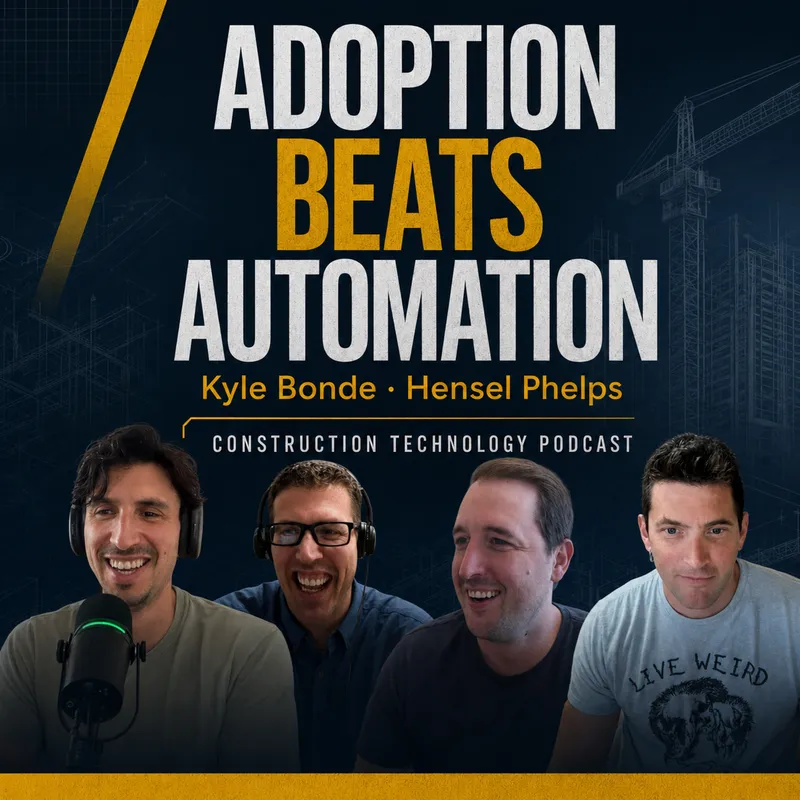
Also on Spotify and Apple Podcasts.
Kyle Bonde is a Senior Estimator at Hensel Phelps. His argument is that the industry has the order backwards: a tool that automates a task but never gets picked up is worth less than a simpler one estimators actually switch to.
Most technology conversations in preconstruction start with capability. Kyle Bonde starts somewhere else. His measure of a tool is whether estimators move to it without being told to, and his position is blunt: automation nobody uses is worthless to him.
He makes the point with an analogy about takeoff software. An older tool is a horse. It does the job. A better tool is the car. The shift from one to the other happened because the car was obviously better to the person doing the work, not because anyone mandated it. Horses went away on their own. What he sees in construction technology is a lot of products promising the self-driving electric car while estimators are still being asked to give up something that works.
That framing has a practical consequence. A rollout that depends on a mandate from above is already in trouble, because the mandate is doing the work the product should be doing.
Hensel Phelps did not start with the hardest problem. They started with bid tabs: archiving them, and pulling a proposal summary out of every bid that came in.
The reason was not that bid tabs were the biggest pain. It was that bid tabs were the point where their data was finally consistent enough to trust. Kyle is candid that the choice felt wrong to him at the time, and that it took a conversation with their CIO to work out why it was right.
Her question was: does the source of truth get generated? That reframed where AI belonged. At the time, the honest answer pointed back at the takeoff, because scope generation did not yet exist as a category of software. The question survives the specifics, and he still uses it.
The most useful part of the conversation is a failure. Hensel Phelps worked with IT to deploy an AI agent company-wide. Into its instructions they wrote a line telling it to deprioritize drawings, on the reasoning that vision models could not read construction drawings well enough to rely on.
They gave it to a handful of people. The output was poor, and users said so.
The failure was not the model. It was the instruction. The team had encoded a belief about what the technology could not do, and that belief was out of date by the time it shipped. It is a specific and uncomfortable example of how an internal assumption becomes an invisible ceiling on a tool, and nobody thinks to question it because it is buried in a prompt rather than visible in the product.
Kyle is direct that conceptual estimating remains underserved, and that the reason is unglamorous. The base data is not there. Cost model tools let you pull history and run comparisons, but nothing takes the full context of a specific job, reads across your own data, and tells an estimator what the number could be and what is missing from it.
He also notes that hard-bid work still runs around thirty percent in some regions, which shapes how much of this is worth solving and for whom.
Quotes are lightly edited for clarity. Listen to the full episode for the full context.
“Adoption beats automation, period. Automation that nobody uses is worthless to me.”
Kyle Bonde, Senior Estimator, Hensel Phelps
“We need to get people to move to the next technology and it just naturally happens, without any mandates. That is magical. Horses just kind of went away.”
Kyle Bonde
“Our CIO challenged me a little, which was a great question. She said, Kyle, does the source of truth get generated?”
Kyle Bonde
“We had a note in the instructions to this AI agent that said deprioritize drawings, because we had this assumption that the VLMs cannot really read the drawings very well. We deployed it to a few people and this thing was giving them really crap information. That was the fail.”
Kyle Bonde
“You have all these cost model tools, you can grab your history and do all those comparisons. But there is nothing that takes the context of your job, looks at all your data, and gives you an executive summary of what could be.”
Kyle Bonde
Kyle Bonde's answer is that it is rarely a capability problem. His test is whether estimators move to a tool on their own, without a mandate. A rollout that needs enforcement is already failing, because the mandate is doing the work the product should do.
Hensel Phelps started with bid tabs, archiving them and pulling a proposal summary out of every bid. Not because bid tabs were the biggest pain, but because that was the point where their data was finally consistent enough to trust.
Hensel Phelps assumed not. They deployed a company-wide agent with an instruction to deprioritize drawings, on the reasoning that vision models could not read them reliably. The output was poor, and the assumption they had written into the prompt turned out to be the problem.
Because the base data is not there. Cost model tools let you pull history and run comparisons, but nothing takes the full context of a specific job, reads across a contractor's own data, and tells an estimator what the number could be and what is missing from it.
Kyle's point is that adoption decides whether a tool is worth anything. This goes into how precon teams actually get people onto new tools, and what training has to cover.