
See how pre-construction teams are boosting win rates and profits with Provision
Book a Demo$100 billion in project value reviewed with Provision
Get through pursuits 2x faster
Chris Murphy of Consigli on what a contractor should buy, and what it should build
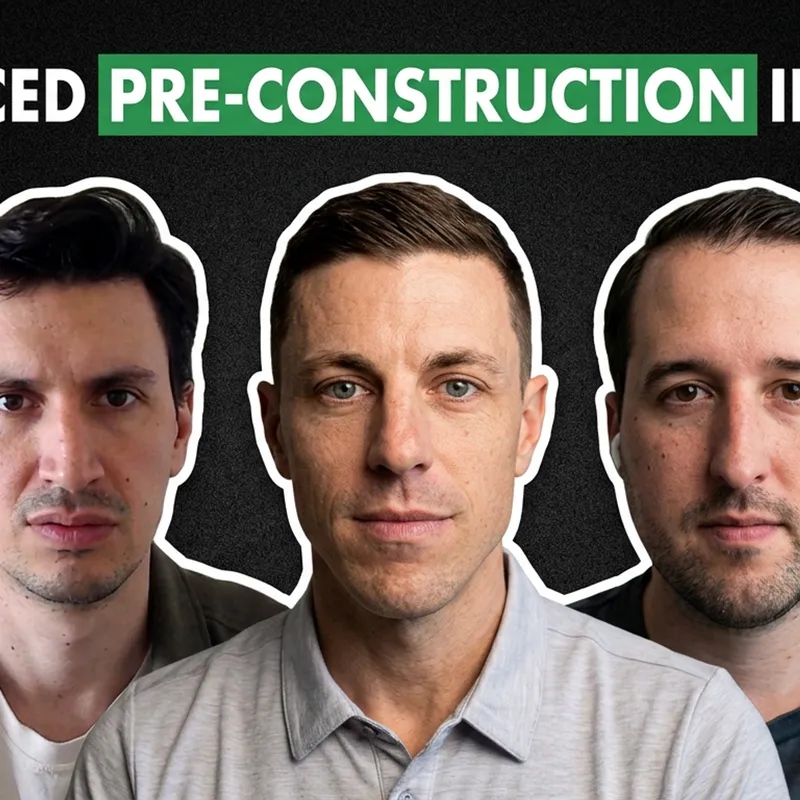
Also on Spotify and Apple Podcasts.
Chris Murphy of Consigli built his team an internal system rather than waiting for one. He is clear about what a contractor should buy, what it should build, and why the data cleanup nobody wants to do comes before any of it.
Consigli stood up a virtual machine environment, put an enterprise agreement in place, and used Claude Code to build an internal smart hub. From starting to showing it at a conference took roughly a month and a half to two months.
That timeline is the interesting part. The capability to build internal tooling has moved inside the reach of a preconstruction team, rather than sitting with a software vendor or a long IT project. Chris was demonstrating what they had built to an industry audience within weeks of starting.
Asked whether contractors should be building their own systems, Chris gives a careful answer. They are not trying to reinvent the system of record. Everyone in the industry has to use something like that, and it provides the cross-operational touch point between the field and the office.
What they want to improve is how their own people operate inside and across those systems. His prediction is that the smartest firms land in a hybrid: buy the mature systems where buying makes sense, then build strategically around them.
It is a more useful framing than the usual build-versus-buy argument, because it separates the system of record from the workflow on top of it. The first is a commodity. The second is where a contractor builds an actual advantage.
On where the technology has got to, Chris is direct: computer vision has become shockingly good. The detail and the breakouts are, in his words, incredible.
His more interesting claim is what follows from that. If the measurement itself is becoming reliable and commoditized, then the takeoff is becoming less valuable than the decisions made around it. What matters is whether the output can be exported in a standard format, ingested, and then used.
He raises a second question that gets less attention than accuracy, and deserves more. Will the estimator retain it? The output can look correct and still fail, if the person responsible for the number does not understand it well enough to defend it. An estimator remembers a lawsuit from 2019 and reads a spec through that memory. Whether a tool can make that kind of connection is a different test from whether it measured the quantity correctly.
The least glamorous part of the conversation is the part Chris is most emphatic about. Getting your base data into shape is the biggest lift, and depending on the size of the firm and how much has accumulated, it can take months or years.
His warning is specific: do that work before assuming a model will solve the problem for you. Dumping everything into a system and querying it does not do what firms expect. You get hallucinations and inaccurate data, which defeats the entire point, because accurate results were the reason for doing any of it.
Quotes are lightly edited for clarity. Listen to the full episode for the full context.
“We do not want to reinvent Procore. Everyone has to use that to a certain extent in our industry. But we want to enhance how our people operate inside and across those systems.”
Chris Murphy, Consigli
“The smartest firms will probably end up in a hybrid scenario, buying mature systems where it makes sense and then building strategically around them.”
Chris Murphy
“Computer vision has gotten shockingly good. Workflow integration is still going to be the hard part, but the takeoff itself is becoming less valuable than the decisions around that takeoff.”
Chris Murphy
“Are the estimators going to retain it? Are they going to understand it? The output will look correct, but is it going to be retained?”
Chris Murphy
“That is the biggest lift. It could take months to years depending on how large you are and how much garbage you have ingested. Focus on that before thinking a model is going to solve all your problems and you just dump everything in and query it. That is not going to do what you think it is.”
Chris Murphy
Chris Murphy's view is a hybrid. Do not try to rebuild the system of record, because everyone has to use something like Procore. Buy the mature systems, then build strategically around them to improve how your own people work inside them.
Consigli stood up a virtual machine environment, put an enterprise agreement in place, and built an internal smart hub using Claude Code. From starting to demonstrating it at a conference took roughly a month and a half to two months.
Chris says computer vision has become shockingly good, and the detail and breakouts are strong. His point is that this makes measurement the commodity, so the takeoff is becoming less valuable than the decisions built on top of it.
Cleaning up your own data, which he calls the biggest lift and says can take months or years depending on how much has accumulated. Dumping everything into a model and querying it produces hallucinations and inaccurate results, which defeats the point.
Chris argues the takeoff matters less than the decisions built on it. Scope Agent works that end: reading drawings and specs together and tracing every scope item back to the sheet and section it came from.