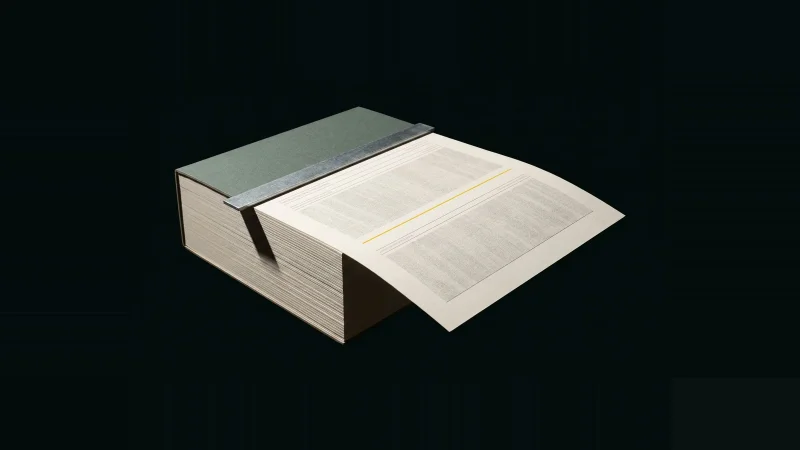
Spec books were already long. A commercial ICI project in 2026 routinely runs 1,500 to 2,000 pages of specifications. Add LEED v4.1 requirements, WELL certification provisions, embodied-carbon reporting mandates, and municipal energy code addenda — and you can add another 150 to 300 pages on top of that.
Estimators are not getting more hours. The bid window is not getting longer. Something gets missed.
This article explains where sustainability specs hide, what they cost when estimators miss them, and how AI designed for construction documents changes the math.
The construction industry tends to frame sustainability requirements as a compliance issue — something the owner's LEED consultant manages. That framing is wrong for GCs, and it costs real money.
Sustainability specs generate scope. That scope has to land somewhere in a subcontract. When it doesn't, somebody absorbs it.
A 2024 Arcadis report put the average North America construction dispute value at $60.1M. "Errors and omissions in contract documents" has repeatedly ranked as a top dispute cause in North America across the years Arcadis has tracked. Sustainability requirements buried in Division 01 general requirements — commissioning, waste diversion, material documentation — are exactly the kind of provision that fits that category.
The pattern is familiar to anyone who's been through a LEED project dispute: the requirement was in the spec. It was just in a section nobody priced.
Many subcontracts include language requiring subs to perform work that is "readily inferable" from the contract documents, even if it isn't spelled out in their scope sheet. That language was already a source of disputes before sustainability specs added volume to the document set.
One Senior PM at a Canadian ICI GC described the pressure this creates: "Our construction management clients expect us to find the scope gaps in the design too now. They expect us to be designers and engineers."
When spec books grow by 20%, the "readily inferable" surface area grows with them. GCs carry more implied risk per project — not because contracts changed, but because documents did.
The Scope Gap Playbook chapter on subcontract language covers how GCs can tighten scope language to limit that exposure. But tighter language only helps if you know what the spec actually requires in the first place.
Sustainability scope doesn't consolidate neatly in one section. It scatters across the document set in ways that make manual review genuinely difficult.
This is where most sustainability administrative requirements live — and where estimators spend the least time per page. LEED documentation obligations, construction waste management plans, indoor air quality protocols during construction, and commissioning authority coordination requirements all tend to appear here.
None of these are free. Waste diversion to 75% or 80% requires bin separation, haul tickets, and documentation. That has a cost. If it isn't in someone's scope sheet, it becomes a conversation mid-project.
MEP specs are already a known risk area. Add WELL or LEED energy performance requirements, demand-controlled ventilation provisions, and enthalpy recovery specifications, and the scope gaps compound. Generator field-conditioning costs — already one of the most-cited recurring gap categories in pre-construction — get more complex when energy-efficiency provisions interact with temporary power requirements.
The Scope Gap Playbook chapter on trade-specific gaps details how MEP scope gaps — from motor starters to fire-rated louvres — tend to surface late and cost more than expected. Sustainability layers on top of those existing risks.
Low-VOC requirements, material transparency documentation (EPDs, HPDs), and recycled-content thresholds appear in finish specs and create downstream procurement constraints. When a sub prices standard product and the spec requires a LEED-compliant alternative with a four-week lead time, the cost difference shows up as a change order.
Sustainability requirements frequently arrive late. An owner adds a LEED certification target after the first issue. Energy modeling results change a mechanical system. A municipal authority revises its embodied-carbon reporting requirement two weeks before bid day. Each addendum requires a full re-read of affected sections — not just the delta.
That's the part manual review handles worst. Most estimators scan addenda for changes, not for interactions with earlier spec sections.
Generic industry statistics on scope gaps are easy to dismiss. Real project examples are harder to ignore.
The Scope Gap Playbook documents a $400,000 missed roof cover board on a $50M project, recovered only through a relational concession from the sub. That gap came from a standard spec section, not a sustainability provision. Now add low-slope roofing energy compliance requirements, R-value specifications tied to energy code, and cover board language that appears in both Division 07 and Division 01 — and the gap potential doubles.
A $300,000 lead-lined glass omission on a hospital imaging suite was absorbed by the GC under "readily inferable" language. The spec was there. Nobody priced it. Specialty sustainability materials — electrochromic glazing, triple-pane assemblies with specific U-factor requirements, low-embodied-carbon structural steel callouts — carry the same risk profile.
A 2018 PlanGrid and FMI study projected $31.3 billion in U.S. rework costs from miscommunication and bad project data, with 26% attributed to communication breakdowns and 22% to bad project data. Sustainability scope gaps drive both failure modes simultaneously: the requirement exists in the documents, but it doesn't make it into the scope sheet, so the sub prices something different and builds something different.
As one Pre-Construction Lead at a Top-ENR Canadian GC put it: "If you miss anything, they'll bill it."
The honest answer is that manual review was already at its limit before sustainability mandates expanded the spec book.
A typical pre-construction team reviews 30 to 40 hours of document work per bid. That time gets compressed as pursuit volume increases and bid windows shrink. Estimators make judgment calls about which sections need a full read. Division 01 general requirements — the primary home of sustainability administrative scope — often gets skimmed.
The anti-patterns are predictable. An Estimating Manager at a Canadian ICI GC described the pressure: "We have less subs who just kind of a gentleman's agreement… they've become more quick to clarify that we're not including that one piece of scope." That's not a sub problem. It's a scope sheet problem. And it starts in pre-construction.
Two of the most common anti-patterns documented in the Scope Gap Playbook apply directly here:
Neither of these is a personnel problem. They're a volume problem. The document set is too large and too complex for manual review to catch everything consistently.
Generic AI tools — ChatGPT, Copilot — can read text. They cannot ingest a full project set of drawings, specifications, and addenda together, cross-reference sustainability requirements across divisions, and produce a structured, cited output that estimators can act on.
That architectural difference matters for sustainability scope review. A LEED commissioning requirement in Division 01 interacts with the mechanical and electrical specs in Divisions 23 and 26. Identifying the gap requires reading both simultaneously and understanding what's missing in the scope sheet — not just what's present in the spec.
Provision's Chat Agent answers specific questions about construction documents — drawings, specs, contracts, RFIs, addenda — with cited answers in under 20 seconds. An estimator can ask "What LEED documentation is required of the mechanical sub?" and get an answer that points to the exact spec section, not a summary that requires a follow-up read.
Provision has answered more than 50,000 queries across a document base covering $100 billion in project value. The Chat Agent carries 95% verified accuracy on real estimator questions. That's the kind of number that matters when you're making scope decisions on a competitive bid.
For scope package generation, Scope Agent generates complete scope-of-work packages from construction documents in under 60 minutes. It reads the full project set — drawings, specs, and addenda together — and surfaces scope requirements by trade. Sustainability requirements buried in Division 01 or called out in energy compliance sections don't require a separate manual pass. They're part of the same extraction process.
Scope Agent has achieved 97% match accuracy on scope item extraction in internal validation testing. A human estimator performing the same exercise averaged 91.3% — at roughly four days per project. The difference in accuracy is meaningful on a LEED project where a missed commissioning requirement or a misclassified low-VOC finish spec becomes a change order.
For contract and spec risk, Risk Review identifies risks with 99% accuracy and cites every finding back to the exact clause, section, or page. It reduces contract and spec review time by 80%. On a project where sustainability provisions span six divisions and three addenda, that reduction in review time is the difference between a thorough pre-bid review and a skim.
AI tools extend the capacity of a pre-construction team. They don't replace the judgment calls that experienced estimators make. The eight habits documented in the Scope Gap Playbook still apply — and some matter more on sustainability-intensive projects.
Sustainability requirements often appear in both the drawings (energy code compliance notes, material callouts) and the specs (documentation requirements, performance thresholds). Starting with the drawings surfaces conflicts that spec-only review misses.
Scope sheets that say "as per plans and specs" do nothing to allocate sustainability scope. The scope sheet needs to reference specific divisions, specific sections, and specific requirements — especially for LEED documentation obligations that subcontractors routinely price at zero.
Before a scope package goes to subs, someone needs to confirm that sustainability administrative requirements are assigned. Commissioning coordination, waste diversion reporting, and material documentation don't belong in a gray area between the GC and the mechanical sub.
A Pre-Construction Lead at a Top-ENR Canadian GC described the standard: "It's descriptive — bread, put it on a plate, use the open jar… You have to get to that level of detail or else they'll just be like, 'you didn't tell us that.'" That applies to LEED documentation requirements as much as it applies to any other scope item.
The full list of eight habits is in the Scope Gap Playbook — built from more than 200 GC interviews and 50 in-depth operator conversations.
Sustainability mandates are not a temporary compliance trend. Municipal energy codes are tightening. Embodied-carbon reporting requirements are expanding. LEED v4.1 and WELL certification are more common on institutional and commercial work than they were five years ago. The spec book will keep growing.
Pre-construction teams have three choices. Hire more estimators. Accept more scope gap exposure. Or use tools that process document volume faster and more accurately than manual review can.
The math isn't complicated. If catching three scope gaps per pursuit pays for an AI tool — as a Senior PM at a mid-market Toronto developer noted — then sustainability-heavy projects with 150 to 300 additional spec pages represent exactly the use case that justifies the investment.
GCs using Provision's pre-construction platform are getting through pursuits twice as fast. Provision has processed more than 100,000 documents and found more than one million risks. Those numbers come from real project sets — not demos.
If you want to see how the platform handles a sustainability-heavy spec book on your next pursuit, book a demo.
Division 01 general requirements contain most sustainability administrative scope — LEED documentation, construction waste management plans, and commissioning coordination. These sections get the least attention per page in manual review, even though they generate real cost obligations that need to land in a subcontract scope sheet.
AI tools built for construction documents ingest the full project set — drawings, specs, and addenda together — and cross-reference sustainability requirements across divisions simultaneously. Manual review typically works section by section. The cross-reference step is where most sustainability scope gaps originate and where AI adds the most value.
Purpose-built construction AI can read and extract requirements from any Division 01 through 49 section, including LEED-specific provisions. Provision's Chat Agent carries 95% verified accuracy on real estimator questions. Scope Agent achieves 97% match accuracy on scope item extraction — compared to a 91.3% human baseline on the same exercise.
They're causing real disputes. The Arcadis 2024 Global Construction Disputes Report put the average North America dispute value at $60.1M. "Errors and omissions in contract documents" has repeatedly ranked as a top dispute cause in North America in Arcadis tracking. Sustainability requirements buried in Division 01 or late addenda fit that category precisely.
Provision's platform ingests addenda as part of the full project set and surfaces requirement changes without requiring a manual re-read of every affected section. Addenda that modify sustainability provisions — common on LEED projects where energy modeling results change system specifications — are processed alongside the original documents.
Yes. The platform reads any construction document — specification section, drawing, contract, or addendum — regardless of the certification framework. WELL, energy code compliance sections, low-embodied-carbon material specifications, and local sustainability bylaws all live in the same document set. Provision processes the full set, not just LEED-tagged sections.
The Scope Gap Playbook covers the eight habits that protect margin on complex document sets, including the anti-patterns most likely to produce gaps when spec books grow. It's built from interviews with more than 200 general contractors across North America.
See how Scope Agent surfaces buried LEED and green building requirements before they become change orders.
See Scope Agent workMore Articles