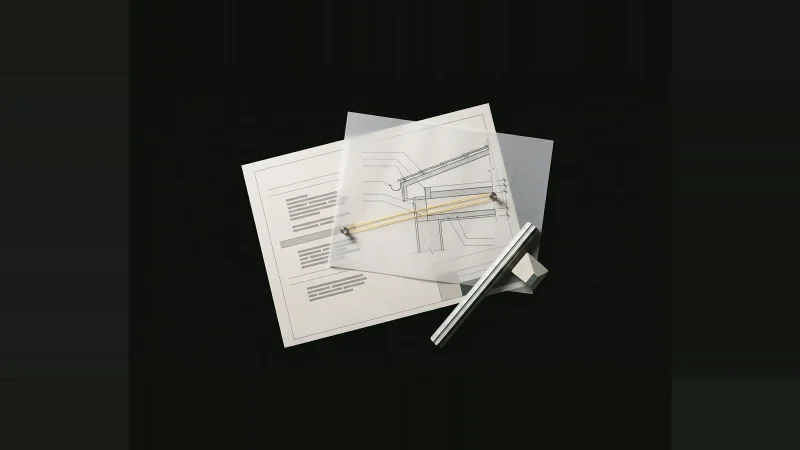
Every estimator has been there. You're 48 hours out from bid day. You pull a detail and it says one thing. The spec section says something else. You don't have time to run it down. You make a call — and three months later, that call costs $300,000.
This is not a rare failure. A 2018 PlanGrid and FMI study projected that miscommunication and bad project data cost U.S. contractors $31.3 billion annually in rework. "Errors and omissions in contract documents" has repeatedly ranked as the top dispute cause in North America, according to Arcadis's annual Global Construction Disputes Report. The average North American construction dispute hit $60.1 million in 2024.
Those numbers are built on conflicts that were findable — before bid day.
The documents in a project set were not written by one person. Architectural drawings, structural drawings, civil drawings, MEP drawings, and the spec book are often authored by different consultants — months apart. They conflict. Always.
The problem isn't that conflicts exist. The problem is that estimators don't have time to find them all.
A mid-market commercial project might have 800 drawing sheets and a 2,000-page spec book. A hospital or institutional build can double that. Cross-referencing every callout in every section against the corresponding drawing note is a full-time job — on a single pursuit.
Most pre-con teams are running three to five pursuits at once. The math doesn't work.
One of the most common anti-patterns in scope writing is pulling a previous scope package and updating the project name. The Scope Gap Playbook — built on 200+ interviews with GC estimators and pre-con leaders — flags this specifically: "copy-paste from the previous similar job" is one of the habits that lets conflicts slip through undetected. The previous job had different drawings. Different specs. Different consultants.
The conflicts you missed on that job are now baked into this one.
The single most-cited scope-writing anti-pattern in the Playbook is the phrase "as per plans and specs." It looks like coverage. It isn't. When a drawing says one thing and a spec says another, "as per plans and specs" doesn't resolve the conflict — it creates a dispute. The sub bills for the higher-cost interpretation. The GC absorbs the gap.
As one Pre-Construction Lead at a Top-ENR Canadian GC put it: "If you miss anything, they'll bill it."
Drawing-spec conflicts are not evenly distributed. They cluster in specific trades and document intersections. Here's where to look — and what it costs when you don't.
These are not hypothetical losses. These are real numbers from real GCs, documented in the trade-specific scope gaps chapter of the Scope Gap Playbook.
Notice the pattern: the conflict exists in the documents. It was findable. It just wasn't found before bid day.
Let's be specific about the workload. A thorough manual drawing-spec cross-reference on a $30M commercial project typically takes:
Across 10–15 active spec divisions, that's 30–40 hours of work. Per pursuit. That's before you've done takeoff, written a scope package, or reviewed subs.
Most pre-con teams don't have 30–40 hours. They have bid day in 72 hours.
So they spot-check. They rely on experience. They make judgment calls. And sometimes those calls cost $400,000.
AI-powered drawing review doesn't replace estimator judgment. It gives estimators the information they need to exercise judgment — fast enough to act before bid day.
The key difference from generic AI tools is document ingestion. A general-purpose AI tool like ChatGPT can answer questions about text you paste into it. That's not useful for a 2,000-page spec book and 800 drawing sheets. You can't paste that. You need a tool that reads the full project set — drawings, specs, and contracts together — and lets you query across all of it.
Provision's Chat Agent is built for exactly this. You upload the project set. You ask a question. You get an answer in under 20 seconds — cited to the exact page, section, and drawing sheet.
Instead of manually comparing spec section 07 54 00 to the roofing details in the drawing set, an estimator asks:
"Does the roofing spec require cover board? Do the roofing details show it in the assembly?"
The tool surfaces both references — the spec clause and the drawing detail — and flags the conflict if they disagree. That query takes 20 seconds. The same check done manually takes 90 minutes.
Provision's Chat Agent has answered over 50,000 queries from real estimators, with 95% verified accuracy on those questions. Every answer is cited to the source — no hallucinations, no guesses.
Catching drawing-spec conflicts is only half the problem. The other half is making sure your scope packages reflect what the documents actually require — not what you assumed.
That's where Scope Agent fits in. It generates complete trade-by-trade scope of work packages from the project's full document set in under 60 minutes. It reads the drawings, reads the specs, and builds the scope package from what both sources say — not from a boilerplate template.
Internal validation puts Scope Agent's scope item extraction accuracy at 97%. A human estimator doing the same exercise manually averages 91.3% — over about four days of work. The gap between those two numbers is where scope gaps live.
The Scope Gap Playbook identifies eight habits that separate firms with tight margins from firms that absorb cost overruns. Drawing review shows up in at least three of them:
AI drawing review tools make these habits executable at scale. Without automation, the pre-issue review is the first thing cut when bid day is close.
Not all construction document AI tools do the same thing. Here's how to evaluate them:
The tool needs to read drawings and specs and contracts — together. A tool that only reads contracts won't catch the conflict between spec section 08 44 13 and the curtainwall elevation drawing. Make sure the tool handles the full document set, not just one document type.
Any answer that doesn't cite its source is a liability. You need to know which drawing sheet and which spec section created the conflict — because that's what goes in the RFI. Tools that summarize without citing are not useful for pre-construction workflows.
Addenda change everything. A tool that can't incorporate addenda without reprocessing the full document set is going to miss conflicts introduced in the last 48 hours before bid. Confirm how the tool handles mid-pursuit document updates.
A list of conflicts is a starting point. A structured, trade-by-trade scope package that incorporates those conflicts is what your subcontractors need. Look for tools that go from conflict identification to scope output — not just a list of flags.
Generic AI tools don't understand that "cover board" in a roofing assembly is different from "cover plate" in structural steel. Construction-specific tools are trained on industry language, CSI divisions, and the way real project documents are organized. That training is what produces cited, accurate answers — not generic summaries.
A Senior PM at a Toronto mid-market developer said it plainly: "If we could catch three scope gaps or three missed items on every scope of work, then this thing pays for itself."
Run the numbers on your own portfolio. What did drawing-spec conflicts cost you in change orders last year? What did they cost in project relationships, in schedule delays, in subs coming back to you with extras?
Firms using Provision have put over $100 billion in project value through the platform. They've found more than 1,000,000 risks — conflicts, ambiguities, missing scope items — across 100,000+ documents. The $400K roof cover board. The $300K lead-lined glass. The $45K slab mismatch. These are the kinds of items that appear when you read the documents carefully.
AI doesn't replace the estimator who knows what cover board is. It makes sure that estimator doesn't have to find it manually in 800 pages of drawings on the morning of bid day.
If your team is still doing full drawing-spec cross-reference manually on every pursuit, you're leaving margin on the table. See what Scope Agent and Chat Agent look like on a real project — book a demo and bring your own documents.
AI drawing review is the use of AI tools to read, cross-reference, and query construction drawings and specifications. Instead of manually comparing drawing callouts against spec sections, estimators can ask questions and get cited answers in seconds — flagging conflicts before they become field change orders.
Yes — purpose-built construction AI tools can ingest drawing PDFs, extract callouts, and cross-reference them against specs and contracts. Generic AI tools like ChatGPT cannot process full drawing sets at this level. The difference is in how the tool was built and what data it was trained on.
Provision's Chat Agent delivers 95% verified accuracy on real estimator questions, with every answer cited to the source document — the exact page, section, or drawing sheet. Provision's Scope Agent extracts scope items at 97% accuracy, compared to 91.3% for human estimators doing the same exercise manually.
Common conflicts include: spec assemblies that call for materials not shown in the drawings (e.g., cover board omitted from a roofing detail), finish specifications that conflict with drawing callouts, MEP equipment requirements that differ between spec sections and plan notes, and structural details that conflict with architectural plans. These are the same conflicts that generate RFIs and change orders on site.
A manual drawing-spec cross-reference on a mid-market commercial project takes 30–40 hours. Provision's Chat Agent answers individual queries in under 20 seconds, cited to source. Scope Agent generates a complete trade-by-trade scope package from the full project set in under 60 minutes — an 80% reduction in review time.
It depends on the tool. Provision is built to handle addenda as they issue — without requiring a full document reprocess. This is critical for late-breaking changes in the 48–72 hours before bid day, which is exactly when conflicts introduced by addenda tend to surface.
It varies by project, but the operator examples are instructive: a $400K missed roof cover board, a $300K lead-lined glass omission, a $45K slab mismatch. Each of these was a findable conflict in the documents. Catching three items per pursuit at those dollar levels more than covers the cost of the tool — often in a single bid cycle.
See how Chat Agent finds contradictions across your full project set in under 20 seconds.
See it in actionMore Articles