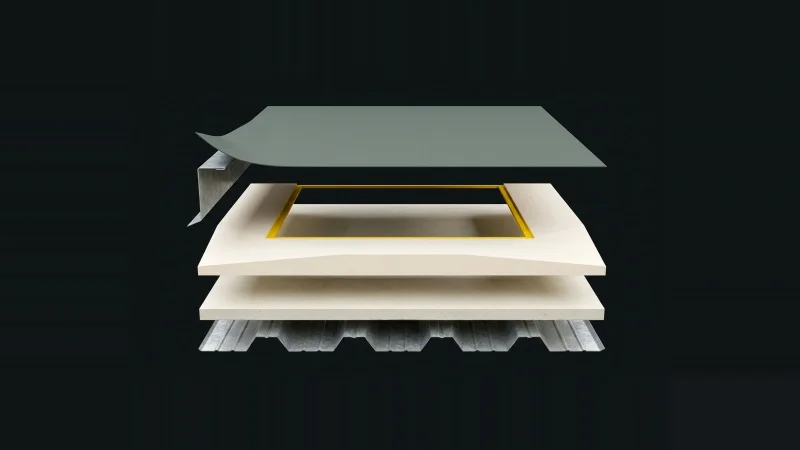
A $50M institutional project. A roofing sub with a clean track record. A scope package that referenced "plans and specs" without defining assembly components. The result: a $400K roof cover board that nobody explicitly assigned.
The GC absorbed it. Not because the sub was wrong. Because the scope package was vague enough that "readily inferable" language in the contract didn't hold up.
This isn't an isolated story. It came directly from the operator interviews behind the Scope Gap Playbook's trade-specific chapter — a research project spanning 200+ GC interviews across North American commercial and ICI construction. Roofing scope gaps appear repeatedly. The patterns are consistent. And they're preventable.
Roofing sits at the intersection of three major cost drivers: envelope performance, MEP coordination, and specialty systems. One roof assembly can touch the waterproofing sub, the metal wall sub, the mechanical contractor, and the drywall trade — all in a 10-foot zone.
Institutional project pipelines are up 22% in 2026 per Dodge data. That growth brings more complex roof assemblies: green roofs, photovoltaic integration, high-performance membranes over occupied spaces. More complexity means more scope boundaries. More scope boundaries mean more gaps.
According to the Scope Gap Playbook, errors and omissions in contract documents have been the top driver of construction disputes for six of the last nine years (Arcadis 2025 Global Construction Disputes Report). Average U.S. dispute value: $60.1M. Roofing and envelope disputes aren't the only contributors — but they're a consistent one.
Cover board sits between the insulation and the membrane. On many assemblies, it's spec'd in the architectural drawings. But it doesn't always make it into the scope package sent to roofing subs.
Why? Because estimators often build roofing scopes from previous similar jobs — one of the most common anti-patterns documented in the Scope Gap Playbook. A scope template from a warehouse build doesn't include cover board. It gets copy-pasted onto a hospital project where cover board is required. The sub prices what's in the scope. Cover board isn't there. Nobody flags it until the assembly is being installed.
The $400K example above wasn't a design omission. The cover board was on the drawings. It just wasn't in the scope package. That's the distinction that matters on bid day. Subs price what you give them in writing. If it's not in the scope, assume it's excluded — regardless of what the drawings show.
As one Pre-Construction Lead at a top-ENR Canadian GC put it: "If you miss anything, they'll bill it."
Flashing disputes are common because flashing touches multiple trades and almost no scope package assigns it explicitly.
Consider a standard parapet condition on a commercial building. The roofing sub installs the membrane. The metal wall sub handles the cladding. The structural steel sub owns the parapet framing. Where exactly does the flashing go? Who installs it — and who supplies it?
The answer is almost never written down. "As per plans and specs" — the most-cited anti-pattern in the Scope Gap Playbook — gets inserted instead. The result: three subs assume someone else owns it. The flashing gets installed late, installed wrong, or triggers a change order when the GC has to assign it post-award.
Masonry-to-storefront transitions carry the same risk. The masonry sub installs to a certain point. The storefront sub starts at a different point. The flashing at the interface sits in a grey zone — unless your scope package names it explicitly and assigns it to one trade.
Caulking scope gaps are almost always a jurisdiction problem. The roofing sub assumes the envelope caulking at roof penetrations is theirs. The exterior caulking sub assumes rooftop penetrations are excluded. The result: either double-billing or an open joint nobody owns.
Interior vs. exterior is the dividing line most scope packages fail to draw. A complete roofing scope package names the specific locations: perimeter caulking at parapet copings, caulking at rooftop mechanical curbs, caulking at roof-to-wall transitions, sealant at counterflashing laps. Each one assigned. Each one referenced to the drawing detail.
Generic scope language like "all caulking as required" creates the gap. Specific scope language like "sealant at all rooftop mechanical curb penetrations per detail A-7.4, supplied and installed by roofing sub" closes it.
The following six items are consistently missing or ambiguous in roofing scope packages at GC firms. Each one has produced a real claim or dispute. Add them to every package before bid day.
Roofing assemblies are some of the most detail-heavy systems in a building. A single low-slope roof assembly might reference the architectural drawings, the structural drawings (for deck type), the mechanical drawings (for curb locations), the specifications (for membrane type), and an addendum (for a revised detail). No sub reads all of those documents with the same depth as a GC estimator.
When a scope package says "install roofing as per plans and specs," it shifts the interpretation burden to the sub. The sub will price the work they know. The components they're less sure about — cover board, tapered insulation, complex flashing details — get priced low or excluded entirely.
This is the core argument in the Scope Gap Playbook's approach to subcontract language: specific document references beat generic incorporation. Instead of "as per plans and specs," name the drawing sheets and spec sections that define the roofing assembly. A2.1, A2.3, A6.1 for roof plan and details. Spec section 07 50 00 for membrane roofing. Spec section 07 62 00 for sheet metal flashing. That level of specificity closes interpretation gaps.
One Pre-Construction Lead at a top-ENR Canadian GC described the standard they use as the "peanut-butter test": "It's descriptive — bread, put it on a plate, use the open jar… You have to get to that level of detail or else they'll just be like, 'you didn't tell us that.'"
Even when a GC catches a roofing scope gap, late discovery is expensive. If the gap surfaces during buyout — after the bid is submitted — the GC absorbs the cost or goes back to the owner for a change order.
The $400K cover board gap above was recovered only through a relational concession from the sub, according to the operator who shared it. That's not a reliable risk management strategy. It worked once. It won't work every time.
The better approach is to front-load the buyout conversation — Habit 3 from the Eight Habits in the Scope Gap Playbook. This means reviewing scope packages for gaps before issuing them to subs, not after. The pre-issue scope review checkpoint (Habit 8) is specifically designed to catch roofing gaps like these before the phone calls start.
Provision's Scope Agent supports exactly this workflow. It reads your full bid document set — drawings, specs, addenda — and generates a complete scope package in under 60 minutes. On roofing, it flags cover board callouts, flashing assignments, and caulking locations directly from the drawings and spec sections. That means your pre-bid review starts with a complete scope, not a blank template.
One reason roofing scope gaps persist is a document volume problem. A 2,000-page spec book for a mid-size institutional project might contain roofing information in five different sections: Division 07 for membrane and insulation, Division 08 for skylight framing, Division 05 for structural deck requirements, Division 22 for roof drain plumbing, and a separate spec for green roof or PV systems. An estimator building a scope package manually doesn't always read all five sections together.
Provision's Chat Agent is built for exactly this problem. Ask it "what does Division 07 say about cover board requirements?" and it returns the answer with citations to the spec section in under 20 seconds. Ask "which drawings show rooftop mechanical curb locations?" and it surfaces the relevant sheets. It doesn't replace a careful scope review — it makes that review faster and more complete.
Provision has processed over 66,000 construction documents and answered more than 50,000 queries across real project sets. The GC workflows built into the platform reflect what estimators actually search for in bid documents — including the roofing assembly questions that take 30 minutes to answer manually.
A complete roofing scope package for a commercial GC should contain at minimum:
The last point matters. Exclusions tell the sub what they don't own. Clarifications tell them what they do own and how you've interpreted an ambiguous detail. The Scope Gap Playbook's Habit 7 — clarifications, not just exclusions — is especially relevant in roofing, where transitions and assemblies are routinely ambiguous in bid documents.
If you want a starting framework, Provision's scope of work template gives you a structured base for roofing and other envelope trades. Pair it with Scope Agent to populate it from your actual project documents.
Roofing scope gaps aren't primarily a design problem. The cover board was on the drawings. The flashing details existed. The caulking locations were in the spec. The gap was in the scope package — the document the sub actually priced from.
That's the distinction that separates GCs who absorb roofing change orders from those who don't. The information exists in the bid documents. Getting it into the scope package — specifically, completely, before bid day — is the operational discipline that protects margin.
For a deeper look at trade-specific scope gaps beyond roofing — MEP, concrete, drywall, envelope — see the trade-specific chapter of the Scope Gap Playbook.
A roofing scope of work is the written document that defines exactly what a roofing subcontractor is responsible for on a project. It should specify the full assembly (insulation, cover board, membrane), flashing assignments by transition type, caulking locations, and references to the drawings and spec sections that govern the work.
The cover board was shown on the architectural drawings but was not included in the scope package issued to the roofing sub. The sub priced what was in the scope. When the GC tried to enforce "readily inferable" contract language, it didn't hold up. The $400K cost was absorbed by the GC on a $50M project.
It depends on what the scope package says — and most scope packages don't say. Flashing at transitions like parapet-to-wall or masonry-to-storefront sits between trades. Assign it explicitly in the scope: name the trade, the detail reference, and whether supply and install are split. Don't leave it to "as per plans and specs."
Define caulking by location and joint type. Separate interior from exterior. List specific locations: perimeter caulking at parapet copings, sealant at rooftop mechanical curbs, counterflashing laps. Assign each to a named trade with a spec section reference. Generic "all caulking as required" language produces gaps.
Provision's Scope Agent reads your full bid document set — drawings, specs, addenda — and generates a complete scope package in under 60 minutes. For roofing, it identifies cover board callouts, flashing assignments, and caulking scope from the source documents. The Chat Agent lets estimators query spec sections and drawings by question, so roofing assembly details surface in seconds instead of hours.
"Readily inferable" contract language means a contractor is responsible for work that a reasonable professional would recognize as necessary — even if it's not explicitly called out. For roofing, GCs sometimes rely on this to cover assembly components like cover board. As the $400K example shows, it doesn't always hold up. Explicit scope language is the only reliable protection.
On institutional projects, the most common roofing omissions are: cover board (not carried into scope from drawings), tapered insulation (excluded without a specific callout), flashing at complex transitions (parapet, skylight, expansion joint), and caulking at rooftop mechanical penetrations. These gaps compound on projects with phased construction or complex roof assemblies.
Scope Agent builds complete roofing scope packages from your bid documents in under 60 minutes.
See Scope AgentMore Articles