Healthcare construction is different. The specs are thicker, the stakeholders are more demanding, and the contracts leave less room for error. A community hospital project can run 2,400 pages of specs before a single drawing sheet is added.
In that environment, MEP and fire protection scope gaps don't stay small. They compound through buyout, through field coordination, and eventually through change orders that erode the margin you thought you were protecting.
With $48 billion in healthcare construction breaking ground in Q1 2026 alone, more GC estimating teams are navigating this terrain under bid-day pressure. This article breaks down the gaps that cost the most — and what to look for before you submit.
Healthcare projects carry regulatory requirements that most commercial work doesn't. FGI Guidelines, NFPA 99, NFPA 101, state health authority amendments, and infection-control protocols all get layered into a spec book that can double the page count of a comparable office project.
More pages mean more places for scope to go missing. They also mean more coordination risk between divisions — and more places where two consultants each assumed the other was covering something.
According to the Arcadis 2025 Global Construction Disputes Report, "errors and omissions in contract documents" has been the top cause of construction disputes for six of the last nine years. The average U.S. dispute value in 2024 was $60.1 million. Healthcare projects — with their complexity, long durations, and infection-control shutdowns — skew well above average.
The gaps that create those disputes aren't random. They follow patterns. MEP and fire protection are where most of them live.
This one shows up on healthcare project after healthcare project. The owner needs the emergency generator commissioned. The generator supplier scope ends at factory testing. Who does the field conditioning — load bank testing, transfer switch verification, fuel system startup — isn't written down anywhere clean.
The result is a scope gap that gets resolved in the field, usually under time pressure, usually at the GC's cost. A Pre-Construction Lead at a Top-ENR Canadian GC described generator conditioning disputes as recurring across multiple projects — "millions" in accumulated costs with no clean contract home.
Before you bid: check Division 26 and Division 33 against each other. Confirm whether the generator supplier's scope of supply ends at the skid. Assign field conditioning explicitly in your mechanical and electrical scope packages, or exclude it with a formal clarification.
Healthcare facilities run a lot of motor-driven equipment: AHUs, exhaust fans, medical vacuum pumps, sterilizer supports. Motor starters and variable frequency drives are specified — but where they appear in the drawings often doesn't match where they appear in the specs.
Mechanical contractors assume electrical is furnishing and installing. Electrical contractors assume mechanical is furnishing with electrical providing connection only. Neither assumption is written down in the scope packages sent at buyout.
This is a classic "front-load the buyout conversations" problem — one of the eight habits documented in The Scope Gap Playbook's trade-specific chapter. Get mechanical and electrical in the same room before you finalize either scope package. Define furnish-install-connect boundaries explicitly, with drawing and spec references.
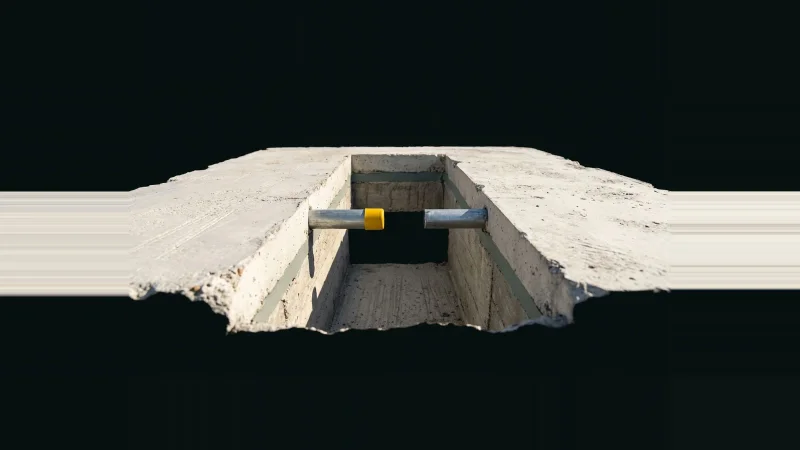
Every major MEP run in a healthcare project crosses a trench at some point. Who digs it, who frames it, who closes it, and who waterproofs it — these questions are almost never answered cleanly in the spec.
Plumbing says their scope ends at the trench edge. Concrete says they backfill after rough-in. Civil says they're not inside the building line. The GC ends up holding the trench as a general conditions item — or eating a change order from whoever ended up doing it.
In your healthcare bid, map the trench routing before you assign scope. Reference the actual drawing sheet and spec section in each affected sub's package. Don't assume "standard" trade boundaries — healthcare is not a standard job.
Healthcare specs require fire-rated louvres at mechanical penetrations through rated assemblies. The problem: mechanical specs describe the louvre. Architectural specs describe the wall rating. Fire protection specs describe the suppression zone. Nobody's spec section says who furnishes and installs the rated louvre assembly.
This gap sits at the intersection of three trades. By bid day, all three have assumed someone else is covering it. If you don't catch it during spec review, you'll catch it during a fire marshal inspection — with opening day six weeks out.
Healthcare lighting control requirements go well beyond a standard commercial job. Infection-control zones, procedure rooms, and neonatal environments have specific dimming, color temperature, and control protocol requirements written into FGI and the local health authority specs.
The gap: electrical subs price standard lighting controls. The spec requires something more complex. The difference — often $40K–$80K on a mid-sized project — surfaces during submittal review, not during bid.
Check Division 26 lighting control specs against the room-by-room requirements in the architectural program. If the clinical room data sheets specify a control sequence, it needs to be in the electrical scope package — with a spec section reference, not a generic "per plans and specs."
Healthcare projects use interim life safety measures (ILSM) and infection-control risk assessments (ICRA) that require temporary fire-rated partitions during phased construction. Those partitions need sprinkler coverage. Who designs the interim sprinkler modifications, who submits them to the AHJ, and who pays for the removal — these are not standard fire protection sub scopes.
On phased hospital renovations, ILSM-driven sprinkler modifications can run $50K–$120K per phase. If it's not in your fire protection scope package, it's a change order waiting to happen.
Healthcare occupancies require smoke compartmentalization under NFPA 101. Stairwell pressurization fans, smoke exhaust systems, and corridor smoke-control dampers are specified across mechanical, electrical, and fire protection divisions.
The scope gap: the mechanical sub prices the fan. The electrical sub prices the power connection. Nobody prices the controls integration, the AHJ testing protocol, or the commissioning documentation the health authority requires before occupancy.
Commissioning and testing on a smoke control system in a healthcare facility can run $30K–$60K. It's not in anyone's standard unit-rate pricing. It won't show up unless someone reads the Division 28 spec closely — and then ties it back to Division 15 and Division 26.
This example comes directly from field experience documented in The Scope Gap Playbook. On a hospital imaging suite, $300K in lead-lined glass was omitted from the glazing scope. The specification was buried in the imaging equipment section — not in the glazing or specialty construction divisions where estimators looked.
The GC absorbed the cost under "readily inferable" contract language. The owner's position: the shielding requirements were knowable from the design program. The GC had no documented basis to dispute it.
This is the "readily inferable" trap at its most expensive. Healthcare specs scatter radiation shielding, acoustic requirements, and infection-control materials across non-standard spec sections. If your scope review is division-by-division without cross-referencing equipment programs and room data sheets, you'll miss them.
The single most cited scope-gap anti-pattern in Provision's research across 200+ GC interviews is the phrase "as per plans and specs." On a 2,400-page healthcare spec set, that language is a $300K gap waiting to happen.
A Pre-Construction Lead at a Top-ENR Canadian GC put it directly: "You have to get to that level of detail or else they'll just be like, 'you didn't tell us that.'" He called it the peanut-butter test — the scope package needs to describe every step, or the sub will claim they didn't know.
Healthcare project programs vary significantly. A critical access hospital has different MEP requirements than an academic medical center or an ambulatory surgery center. Copy-pasting scope packages from a previous hospital job means you're pricing the wrong building.
The Scope Gap Playbook documents this as one of the highest-risk anti-patterns. The familiarity of the project type creates false confidence. The gaps are in the details that changed — and healthcare details change a lot between projects.
Healthcare bids have long lead times — but the scope review often still happens in the 48 hours before submission. By then, the RFIs are closed, the addenda have been absorbed, and there's no time to resolve a conflict between Division 21 and Division 26 on fire suppression zone boundaries.
The firms that catch these gaps build in a pre-issue scope review checkpoint — Habit 8 in the Eight Habits framework — before scope packages go to subs. That means reviewing the MEP divisions against each other, not just reading them in sequence.
This isn't exhaustive — but these are the items most likely to produce a change order or a dispute on a healthcare project in 2026.
Healthcare specs are where manual review breaks down. There's too much to read, too many cross-references, and too little time on bid day.
Provision's Chat Agent lets estimators query across the full document set — drawings, specs, addenda, and room data sheets — in under 20 seconds per query. Instead of hunting through a 2,400-page spec for every "motor starter" or "fire-rated louvre" reference, you get cited answers with section and page numbers.
Provision's Risk Review runs a structured checklist against healthcare specs — including MEP and fire protection trade scopes — with 99.5% accuracy on pre-built checklists. It flags items like unassigned generator field conditioning, missing trench ownership language, and unresolved fire protection zone conflicts before they become RFIs.
And for teams building scope packages under bid-day pressure, Scope Agent generates complete scope-of-work packages from your construction documents in under 60 minutes — with document-referenced inclusions and explicit exclusions that hold up at buyout. GCs using Provision have reviewed over $100 billion in project value and processed more than 66,000 documents. The EllisDon case study documents $1.8M in documented savings on a single project.
Healthcare bids are high-stakes and high-complexity. The firms that win them — and protect their margins — are the ones that catch MEP and fire protection scope gaps before bid day, not after. See how Provision works for GC preconstruction teams or request a demo to see it on a healthcare document set.
Generator field conditioning, motor starter furnish-install-connect boundaries, unowned trench scope inside the building line, fire-rated louvre assignment across trades, and lighting controls that don't match clinical room requirements. These five items appear repeatedly across healthcare bids and rarely get clean spec language.
Healthcare fire protection spans multiple spec divisions — NFPA 99, NFPA 101, Division 21, Division 28, and architectural phasing plans. Interim life safety measure sprinkler modifications and smoke control commissioning requirements are rarely in anyone's standard sub pricing. Scope review has to cross-reference all of these divisions, not just Division 21.
Readily inferable language in GC contracts means the owner can argue that a scope item was knowable from the design documents, even if it wasn't explicitly assigned. Healthcare specs are dense enough that courts and arbitrators have accepted this argument on items like radiation shielding — costing GCs hundreds of thousands with no change order recourse.
Generator suppliers typically scope to factory testing only. Field conditioning — load bank testing, transfer switch verification, fuel system startup — isn't assigned to mechanical or electrical by default. On healthcare projects with emergency power requirements, this gap can run $50K–$200K. Resolve it at buyout, not in the field.
Don't review divisions in sequence — review by interface. Map where Division 15, 21, 26, and 28 interact around key systems: generators, smoke control, ILSM partitions, and major mechanical rooms. Cross-reference against room data sheets and the imaging or lab equipment programs. Use document-search tools to find every instance of contested terms across the full set.
Provision's Chat Agent queries across drawings, specs, addenda, and room data sheets — returning cited answers in under 20 seconds. Risk Review runs structured MEP and fire protection checklists against the spec with 99.5% accuracy. Scope Agent generates complete, document-referenced scope packages before bid day.
Provision's Scope Gap Playbook covers MEP, fire protection, envelope, concrete, steel, and specialty trade gaps in detail — with anonymized dollar examples from real GC projects. The trade-specific chapter is available at provision.com/ebooks/scope-gap-playbook/trade-specific-scope-gaps.
Scope Agent reviews your full healthcare document set and flags unassigned trade scope in under 60 minutes.
See Scope Agent workMore Articles